
How to Measure Reactive Agility Using Your Smartphone
The “SO Vision” feature makes SwitchedOn the first mobile app to automatically measure reactive agility using only your smartphone camera and AI.
Reactive agility is one of the most important and most misunderstood skills in sport.
Athletes rarely move in pre-planned patterns. Instead, they constantly perceive information, make decisions, and react under time pressure. Until now, measuring this ability required expensive hardware, complex setups, or subjective timing.
The SwitchedOn app’s SO Vision feature changes that. Read on to learn how it works.
-
What Is Reactive Agility?
The Problem With Traditional Agility Testing
Why Measure Reactive Agility?
How SO Vision Measures Reactive Agility (with video)
Practical Use Cases
Conclusion
What Is Reactive Agility? The True Definition of Agility
Agility is often confused with change-of-direction speed, but the two are not the same.
True agility is defined as “a rapid whole-body movement with change of velocity or direction in response to a stimulus” (Sheppard & Young, 2006).
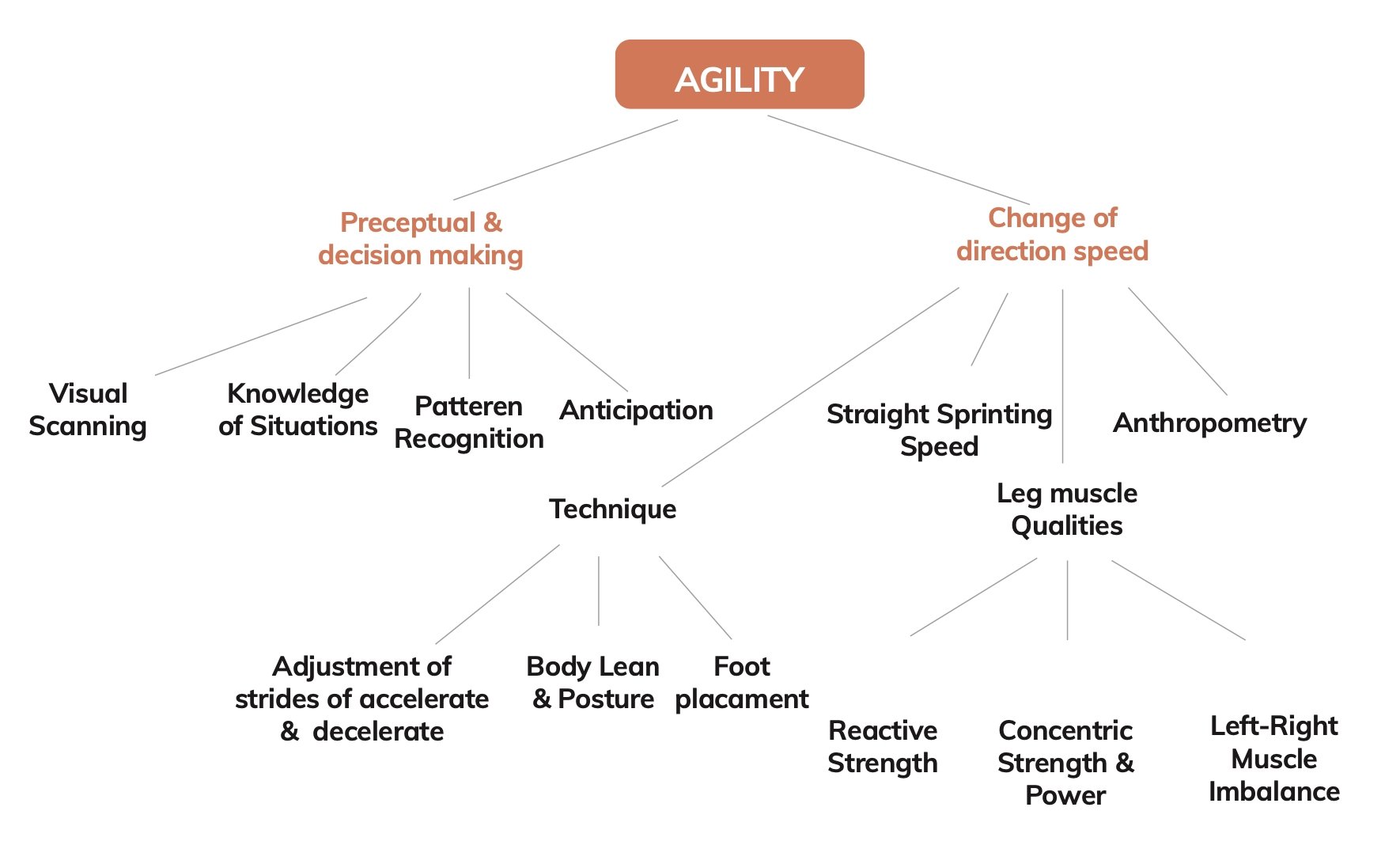
This definition is critical. Without a stimulus and a decision, there is no true agility. Pre-planned drills measure physical movement capacity, but they remove the perceptual and decision-making demands that drive performance in sport.
Reactive agility integrates:
Perception of an external stimulus
Decision-making under time pressure
Rapid whole-body movement
In short, reactive agility is true agility and best represents how athletes actually move and perform in competition.
The Problem With Traditional Agility Testing
Despite how agility is defined in the research, most testing methods fail to measure reactive agility. Common approaches include:
Stopwatches
Stopwatch-based tests are still widely used, but they have major limitations:
They measure pre-planned change of direction, not true agility
Timing accuracy is affected by human reaction error
They provide only a single total time with no breakdown
Reaction Light Systems
Reaction light systems introduce a stimulus, but they create other barriers:
They require expensive, specialized hardware
The setup and space requirements limit accessibility
Many systems only measure when an athlete reaches a target, not when they initiate movement
As a result, many agility assessments fail to capture when the athlete actually reacts.
Why Measure Reactive Agility?
Reactive agility testing provides insights that traditional change-of-direction tests cannot.
Research shows that reactive agility tests more effectively distinguish higher- and lower-level athletes than planned tests (Lockie, et al. 2014). This is because higher-level performers tend to perceive information more quickly and make more effective decisions, not just move faster.
Reactive agility testing also:
Better reflects real game demands (Farrow et al., 2005)
Captures both decision-making speed and movement speed
Helps identify whether limitations are cognitive or physical
Provides more actionable data for training and return-to-play decisions
For coaches, clinicians, and practitioners, this leads to better assessments and more targeted interventions.
How SwitchedOn’s Vision Feature Measures Reactive Agility
SwitchedOn’s Vision feature uses your smartphone camera and computer vision AI to automatically measure reactive agility performance.
How It Works
Create a drill in the SwitchedOn app using the Vision transition setting
Position the phone to capture the athlete’s movement
A random visual stimulus is presented
The athlete reacts and moves
The front-facing camera automatically detects and timestamps key performance events
No stopwatches or external hardware required.
What It Measures
From each repetition, SO Vision automatically calculates:
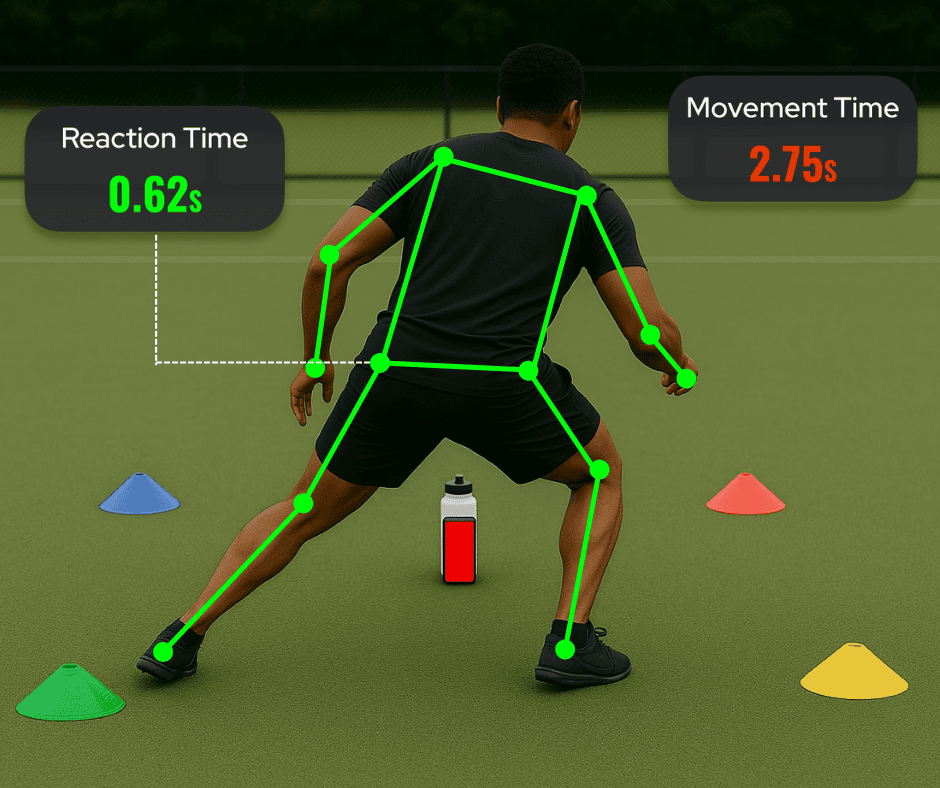
Reaction time: Time from stimulus onset to initial movement, defined as when one hip leaves the starting box
Movement time: Time required to complete the movement and return toward the start
Total agility time: Time from stimulus onset until both hips return inside the starting box, combining reaction and movement time
This allows practitioners to understand not only how fast an athlete moved, but also how quickly they perceived and responded to the stimulus.
Practical Use Cases
SwitchedOn’s Vision feature is designed for real-world environments, including:
Team sport performance testing
Return-to-play and ACL rehabilitation
Athlete monitoring and benchmarking
Youth development and talent identification
Research and coach education
Because it is software-based, Vision can be used by individuals, teams, clinics, and remote athletes.
Conclusion
Reactive agility is true agility. Until now, measuring it accurately required expensive equipment or subjective timing methods.
SwitchedOn’s Vision feature combines sport science and AI to make reactive agility measurement accessible, objective, and scalable using a device you already own.
Download SwitchedOn for free using the buttons below.