
The Science & Benefits of Cognitive-Motor Training
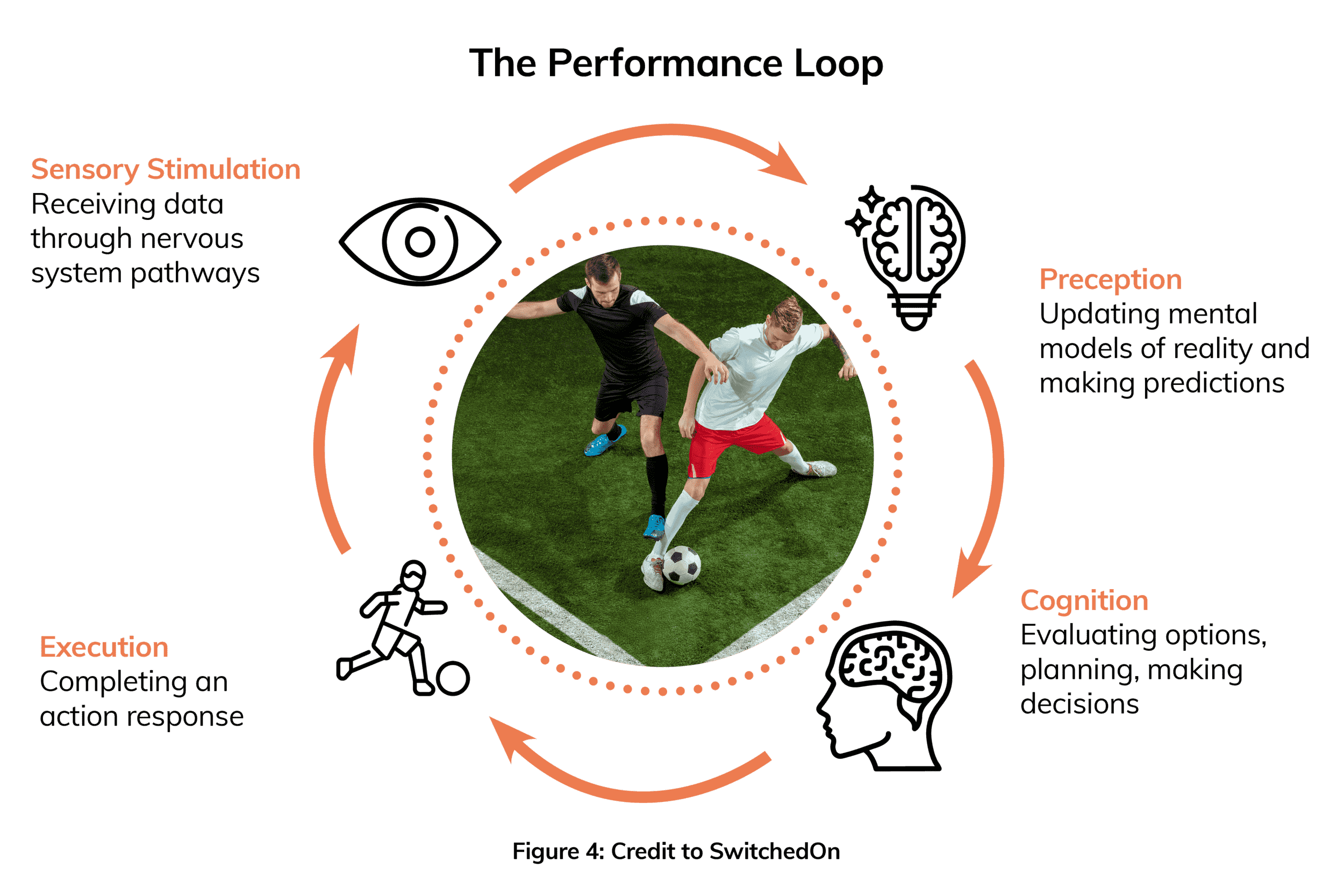
Everything you do in sports and life involves perceiving outside information, processing it to decide on the appropriate response, and then reacting as quickly and efficiently as possible. SwitchedOn’s cognitive-motor training (CMT) methodology harnesses the power of this perceive, decide, and react process using the SwitchedOn app to help you achieve better results faster.
The Science
CMT training is supported by 4 key scientific principles (E.P.I.C)
External focus
Most training involves looking down at your feet and focusing internally on the movement itself, but PCM training forces you to get your eyes up and focus your attention on the environment around you.
Perception-action coupling
Most training involves performing only physical repetitions, but PCM training forces you to make split-second decisions which activates the entire nervous system (brain and body).
Inconstancy (aka variability/unpredictability)
Most training involves performing preplanned and predictable movements over and over, but PCM training provides an element of randomness, unpredictability, and chaos.
Challenge and pressure
Most training doesn't challenge athletes to perform at game speed, but PCM training helps provide an environment with controlled external pressure to help challenge athletes to the optimal amount.
The Benefits
-
Cognitive abilities, such as reaction time, decision-making, working memory, attentional control, anticipation, and executive functions, have been found to be characteristic of elite and high-performing athletes (Walton, et al. 2018). While the ability to improve these skills is well established, traditional cognitive training methods (which involve performing cognitive tasks without sports-specific movements) lack sufficient evidence of these improvements transferring to sports performance (aka far transfer).
One of the main reasons for this is that they lack the integration of perception, cognition, and motor execution, which are deeply intertwined (Renshaw et al., 2018). Cognitive-motor training (CMT) addresses this issue, and recent research comparing this to traditional training showed CMT led to greater improvements in cognitive abilities such as reaction time (+5.4%), decision-making accuracy (+25.8%), and heightened activity in brain areas dealing with anticipation, as well as greater improvements in sports-specific tests (+17%) (Lucia, et al. 2021, 2023).
-
Skill is one of the most challenging things to develop in sports, and some research suggests it can take up to 10,000 hours to develop it to an elite level (Ericsson, A., 2008). Cognitive-motor training (CMT) adds 2 powerful things to skill training to help acquire them faster and improve their transfer to competition: external focus and randomness.
Over 20 years of research by Gabby Wulf and colleagues show training with an external focus leads to better learning and performance of sports skills compared to an internal focus. Research also suggests random practice (performing multiple skills in a random order) has the potential to improve the retention and transfer of sports skills up to 40% more than blocked training (performing the same skill over and over) (Shea et al., 1979).
-
One of the main reasons athletes choke under pressure is due to shifts in their attention. Research suggests that athletes choke under pressure because they focus their attention on task-irrelevant external information (i.e., the crowd) or internal information (i.e., their own movement mechanics). In contrast, athletes who performed well under pressure continued to focus their attention on task-relevant external information (i.e., their teammates, the opponents, etc.) (Eysenck, et al. 2007).
Cognitive-motor training helps athletes practice focusing their attention on task-relevant external information during skill training by requiring them to respond to randomized external cues provided by the SwitchedOn app. This approach has been found to improve athletes' attentional functions (Casella, et al. 2022), and improving these attentional functions has been found to help prevent choking under pressure (Ducrocq, et al. 2016).
-
In the sports community, injuries of the anterior cruciate ligament (ACL) are one of the most common and devastating injuries (Gokeler, et al. 2019). Recent research suggests that athletes can reduce risk factors for ACL injuries by training movements in an environment that incorporates more unpredictability (Mercado-Palomino, et al. 2020) and perception-action coupling (Tidman, et al. 2020), both of which are hallmark traits of cognitive-motor training.
In the active aging community, falls are among the leading cause of bone fractures. According to a meta-analysis (which is commonly considered the gold standard of evidence) by Okubo, Schoene, & Lord (2016), reactive step training (stepping in a direction in response to a randomized external stimulus) resulted in a 50% reduction in falls in elderly adults.
-
Constantly repeating the same preplanned mindless drills can lead to boredom and decreased motivation. Cognitive-motor training (CMT) adds an element of unpredictability, pressure, and challenge which has been found to increase overall enjoyment in training (Niederer, et al. 2019).
We’ve also had the pleasure of experiencing this firsthand from the countless SwitchedOn users who have told us that our app has made their training more fun and engaging and makes them want to come back for more!
-
After ACL reconstruction, 1 in 5 athletes sustains reinjury upon returning to their sport. Traditional rehab protocols focus primarily on restoring physical function, but recent research shows that significant changes in the brain and nervous system can play a large role in these high reinjury rates (Gokeler, et al. 2019).
Cognitive-motor training can help restore these neurological functions post ACLR by progressively introducing exercises that involve external focus, decision-making, and unpredictability, which better replicates the cognitively demanding environment athletes must perform in during competition, but doing so in a controlled setting.
-
Currently, around 50 million people live with severe cognitive impairment worldwide (Gela et al., 2022). While physical and cognitive training separately has been found to improve brain function, recent research suggests that combining physical and cognitive training (i.e., cognitive-motor training) might improve brain health better than training them separately (Gheysen, et al. 2018).
Our Science Advisors


More Information and Resources
Free scientific whitepaper on the neuroscience of athletic performance (click here).
Online course on the science behind cognitive-motor training and how to apply it using the SwitchedOn® app (click here).
Download the SwitchedOn app for free on iOS or Android (click below).